What Cheese category does Parmigiano-Reggiano DOP belong to, and where is it produced?
Parmigiano-Reggiano DOP is an extremely famous cheese exported throughout the world. This cheese belongs to the category of hard pressed cheeses, which are cheeses that can be conserved for long periods of time thanks to their low percentage of water.
Parmigiano-Reggiano (DOP since 1996) is exclusively produced in the provinces of Parma, Reggio Emilia, Modena, Bologna (on the left side of Reno river) and Mantova (on the right side of Po river). In this territory alone we can find over 3,500 small farms, and more than 350 dairies which process and age the cheese for at least 12 months.
Are there specific characteristics involved in the feeding of cows that are used to create Parmigiano Reggiano DOP?
The inimitable characteristics of Parmigiano-Reggiano come from a profound bond with the territory and from the preservation of traditional production practices: cows are never given fermented or silage fodder, and feed used is free of any animal origins or food industry by-products.
The cheese itself is absent from any additives, and includes exclusively natural ferments, and a very extended long aging period.
How is Parmigiano-Reggiano DOP prepared?
Milk is stored in each farm’s dairy, and milk from an evening milking is kept through the morning in large tanks. In these tanks, the milk spontaneously undergoes a separation between liquids and fat, which is subsequently used for the production of butter.
In the morning, the liquid milk is poured into copper cauldrons with a typical upside-down bell shape. This evening milk is then blended with the milk just harvested from the farm’s cows that morning.
The addition of natural whey, rich in lactic ferments from the previous day’s ferments, and calf rennet allows the milk to coagulate.
Only the addition of calf rennet and natural whey, rich in lactic ferments obtained from the previous day's processing, allows the milk to coagulate.
The curd obtained is then broken down into tiny grains with the use of a tool called the spino. The grains are then cooked until they reach a temperature of 55°C. Once the grains have reached this temperature, they form into a collection of caseous granules on the bottom of the boiler, and into a mass.
How do we define the quality of Parmigiano-Reggiano DOP?
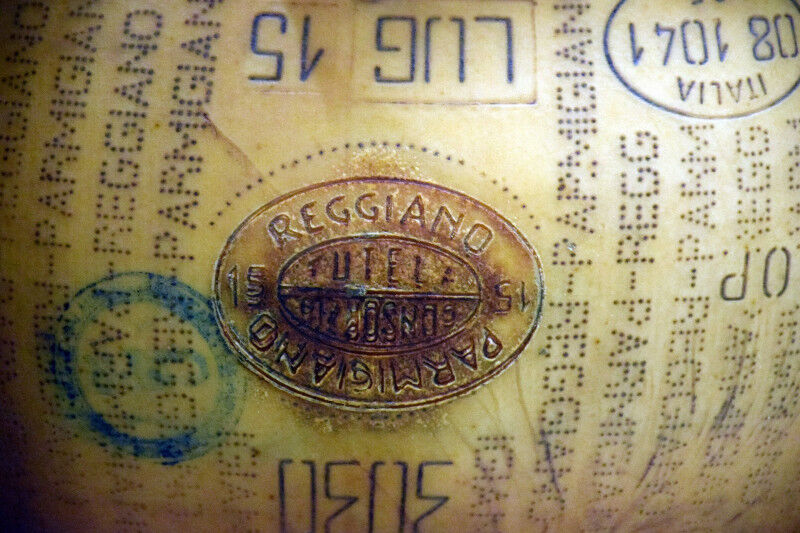
The exterior of each “scalzo” or wheel of cheese is branded with a unique stamp indicating the month and year of production. This distinguishes the dairy where the Parmigiano-Reggiano selection is crafted.
Each wheel is then immersed in a solution of water and natural salt. During this period, which can last more than two weeks, the cheese absorbs salt and loses water.
Afterwards, the cheeses are placed once again into the maturing warehouses: the cheese continues to lose humidity, the rind is formed and the long process of fermentation of the paste begins.
The Consortium requires these 12 months for certification, and it is during these 12 months that the cheese will acquire the special qualities the discipline requires in order to bear the PDO Parmigiano-Reggiano name. Only following these 12 months, the cheese may continue on its long aging process, going past its initial 30 months.
What are the sensorial characteristics of Parmigiano-Reggiano DOP?
When tasting a Parmigiano-Reggiano, it’s impossible not to take note of the complexity of aromas and flavors generally expressed. These elements are present thanks not just to the cow’s nutrition, but also thanks to the long ageing times of the cheese.
The sensorial characteristics of this cheese can therefore be considered in continuous evolution.