Serena:
These are absolutely unlike anything else I've made. So totally worth the extra work - at first my folding was a bit shaky but the more you go throug...
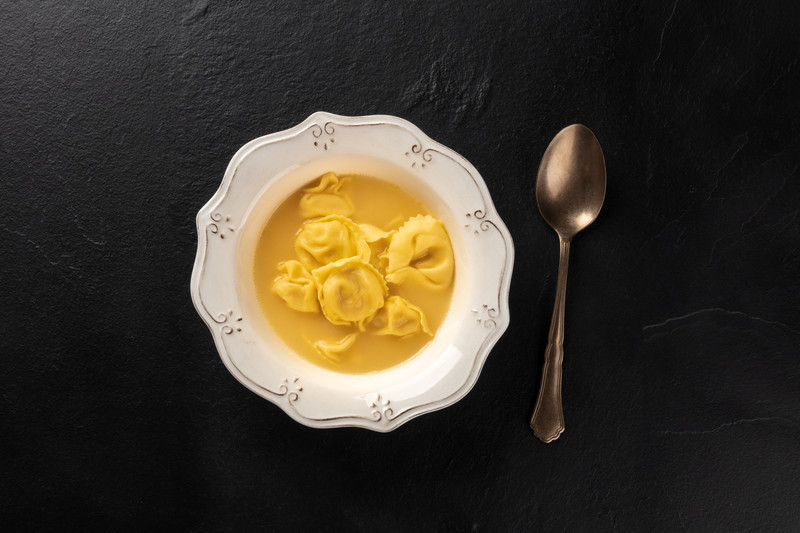
This iconic winter and festive dish, Tortellini in Brodo, elevates simplicity into a celebration of northern Italian culinary tradition. Each element, from the golden egg pasta to the savory meat filling, deserves patient craftsmanship—grant yourself the time to learn this time-honored delicacy.
Both Bologna and Modena fiercely claim the tortellino as their own, sparking endless debates about its true origins. Instead of taking sides, why not enjoy this regional treasure whenever possible?
The roots of this recipe run deep—references to tortellini date as far back as a parchment from 1112 and a papal bull issued by Pope Alexander III in 1169. As with many legendary dishes, centuries have shaped and refined its preparation, resulting in the refined recipe that graces our tables today.
Want more authentic Italian inspiration in your kitchen? Subscribe to our newsletter for the latest traditional recipes, wine insights, and culinary tips delivered straight to your inbox each week. La dolce vita is just a click away.
Explore even more classic Italian recipes and discover the stories behind Italy's finest wines in our blog.
IngredientsTry it with...
Preparation
for 4 servings
Step
1
Of 5
In a large stockpot, combine cold water with cleaned, whole vegetables—such as carrots, celery, and onions—for maximum flavor extraction.
Place assorted cuts of beef and marrow bones (well rinsed) into the pot alongside the vegetables. Set the pot over medium heat; once the water approaches a boil, reduce the heat to achieve a gentle simmer and cook for about 2 hours.
Skim off any foam or impurities that rise to the surface periodically with a skimmer to ensure clarity. Toward the end of cooking, season generously with salt to bring out the broth's flavors.
Strain the finished broth through a fine-mesh sieve, discarding solids. Reserve the clear, deeply flavored broth for serving.
Step
2
Of 5
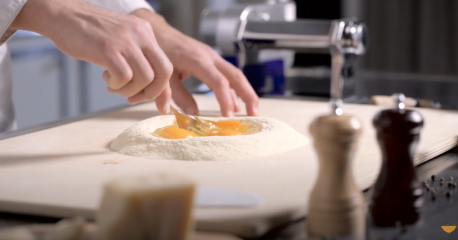
On a clean workspace or in a large bowl, mound your flour and create a well in the center. Crack the eggs into the well, then use a fork to gradually incorporate flour, forming a shaggy dough.
Knead the dough by hand on a floured board for 3-4 minutes, working until you have a smooth, elastic ball. If the dough feels sticky, sprinkle in more flour; if too firm, add a few drops of water.
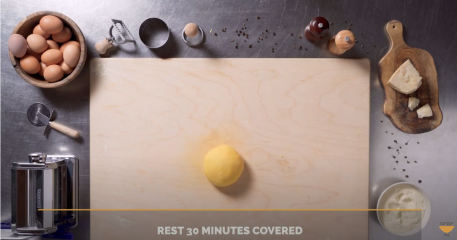
Wrap the dough in plastic wrap and let it rest at room temperature for at least 30 minutes to relax the gluten, ensuring a tender pasta sheet later.
Step
3
Of 5
Slice the pork and gently sauté it in a pan with a knob of butter over low heat, seasoning lightly with salt. Allow to cool completely. Meanwhile, finely grate Parmigiano Reggiano and roughly chop both Prosciutto di Parma and Mortadella di Bologna.
Once the pork is cooled, combine it with the prosciutto and mortadella in a food processor or robust blender. Blend until the mixture is finely ground and homogeneous.
Add the grated Parmesan, a pinch of freshly ground nutmeg, and black pepper to the mix. Pulse until everything is well incorporated. Taste the filling and, if needed, adjust the salt—keep in mind that both the cheese and cured meats are naturally salty.
Step
4
Of 5
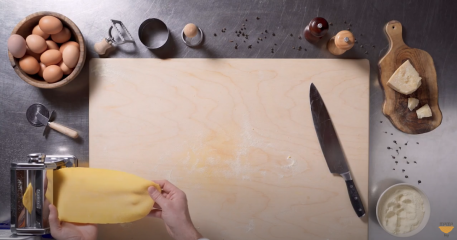
Roll out the rested dough with a pasta machine, gradually adjusting the thickness until you reach a thin sheet, about 0.5 cm thick.
Alternatively, use a rolling pin if you’re skilled, working on a wooden board for tradition’s sake. Cut the dough in half, covering the unused portion to prevent drying.
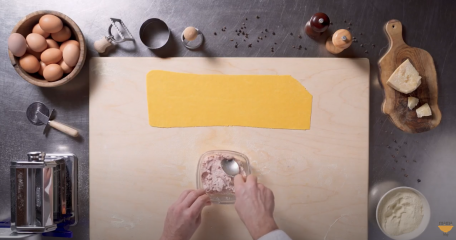
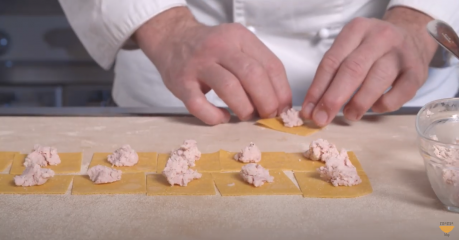
Cut the dough into 3–3.5 cm squares using a pasta cutter. Spoon a small amount of filling onto the center of each square. If the dough edges feel dry, lightly moisten them with your fingertip.
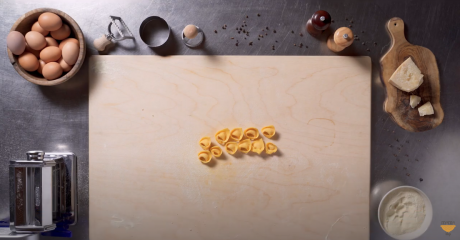
Fold each square diagonally into a triangle, sealing the edges securely. Next, fold the tip upward and gently press around the filling. Wrap the side corners around your finger—traditionally the index or pinky—overlapping the ends and pinching them to seal, forming the signature tortellini shape.
Place each finished tortellino on a lightly floured wooden board, ensuring they don’t touch or stack to prevent sticking.
Step
5
Of 5
Return the reserved beef broth to a gentle boil over medium heat. Add the freshly made tortellini, cooking them for 3–4 minutes, or until they float and are tender.
Remove the pot from the heat and allow the tortellini to rest in the hot broth for another 3–4 minutes, letting the flavors meld.
Ladle the tortellini and broth into warmed bowls. Finish with a dusting of freshly grated Parmigiano Reggiano and a sprinkle of cracked black pepper. Serve immediately for an unforgettable taste of Emilia-Romagna’s culinary heritage.
Try it with...
Filippo Bartolotta
...Great Italian Goodies!
Serena Thursday 5th of November 2020
Uniquely delicious
These are absolutely unlike anything else I've made. So totally worth the extra work - at first my folding was a bit shaky but the more you go through, the more you get used to folding and pressing in the right order. I made the filling the day before to speed things up a bit, but I still had to wait for my dough to rest, so I just focused on the broth instead while it was resting. I saved the broth solids and ate the meat and veg the following day - did discard the bones though!