Ethna:
Fresh pasta has most definitely become a family favorite during lockdown, and being a vegetarian household, we are always looking for options to spice...
If you're passionate about homemade pasta, you're probably familiar with ravioli stuffed with spinach and ricotta. But have you experienced the delightful twist of using Swiss chard? This vibrant leafy green, cherished during the colder months, brings a unique flavor and nutritional punch to your kitchen. Making stuffed pasta from scratch is a true labor of love, and in this recipe, you'll be rewarded with the fragrant, comforting essence of a time-honored yet modern Italian classic.
The filling comes together swiftly, especially if you have your fresh pasta dough prepped in advance—making this impressive meal easier to achieve than you might expect. With a handful of simple ingredients and gentle cooking techniques, you can bring the authentic taste of Italy's beloved pasta dishes straight to your table.
Are you interested in foraging and experimenting with alternative wild greens in your Italian cooking? Discover more about this fascinating culinary adventure in the detailed foraging guide.
Pondering which wine will elevate your ravioli feast? Explore expertly curated wine pairings in our wine recommendations for a perfect match.
Subscribe to the Mamablip newsletter for a treasure trove of tips and inspiration to master Italian cuisine like a local!
IngredientsTry it with...
Preparation
for 4 servings
Step
1
Of 4
Begin by blanching your chosen greens—spinach or, for a more rustic flavor, Swiss chard—in a minimal amount of water. If using spinach, the water clinging to the leaves after washing is sufficient. Simmer for several minutes until wilted, then drain thoroughly and allow to cool.
Once cool enough to handle, press out as much moisture as possible; a sushi rolling mat is an excellent tool for this step. Chop the greens finely. Ensure your ricotta is well-drained; for a silky texture, either sieve it or smooth it using a wooden spoon.
Combine the ricotta with the chopped greens, a generous handful of grated Parmigiano Reggiano, some lemon zest or fresh marjoram leaves, and season generously with salt, black pepper, and a hint of nutmeg. Stir everything together until you have a smooth, cohesive mixture that's firm enough to hold its shape.
Step
2
Of 4
On a clean surface, sift your flours into a mound. Create a well in the center, crack in the eggs, and sprinkle with a pinch of salt. Use a fork to beat the eggs, gradually incorporating the surrounding flour, taking care not to let the liquid escape. Once the dough starts to come together and is no longer sticky, begin kneading with clean hands—dust with extra semolina if necessary.
Knead for about ten minutes, until the dough is smooth and elastic. Wrap in plastic or a clean cloth and let it rest for 20 minutes. After resting, divide the dough into 2–3 pieces, keeping the unused portions covered to prevent drying.
If rolling by hand, work each piece on a floured surface to a thickness of 1–2 mm, rolling from the center outward. If using a pasta machine, start with the widest setting, folding the dough over itself 2–3 times, then progressively roll thinner, finishing at the second-thinnest setting.
Cut the dough into strips or desired shapes. To form ravioli, you have two options:
Option 1: Lay out long strips (about 10 cm wide) on a floured surface. Place small mounds of filling (about 3 cm apart) along one strip. Cover with a second strip, pressing around each mound to seal and release air. If needed, brush the edges with an egg white wash. Cut into individual ravioli, leaving a 1–2 cm border.
Option 2: For a half-moon shape, cut dough into circles with a cookie cutter (8–9 cm). Place a spoonful of filling just off-center, fold over to form a semicircle, and seal the edges with a fork.
Arrange the finished ravioli on a tray dusted with semolina, keeping them separate to prevent sticking, until ready to cook.
Step
3
Of 4
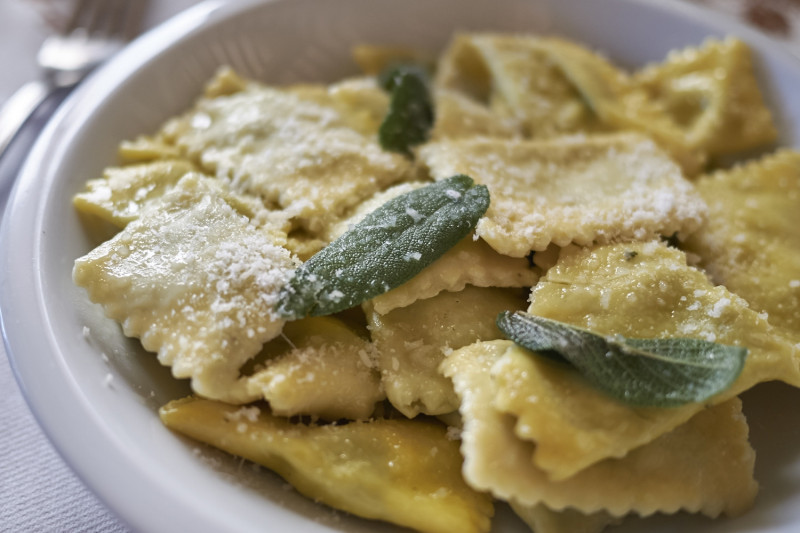
For the sauce, tear fresh sage leaves into small pieces to release their essential oils. In a medium sauté pan, melt butter gently with the sage over medium heat. Allow the butter to foam and take on a golden hue, infusing with sage aroma and making the leaves crisp. For a more pronounced, nutty flavor, let the butter turn a deeper brown before removing from heat. This traditional sauce, called burro e salvia, is a staple in Northern Italian cuisine, prized for its simplicity and elegance.
Step
4
Of 4
Bring a large pot of salted water to a rolling boil. Gently add the ravioli and cook for about 5 minutes, or until they rise to the surface and are al dente. Carefully remove with a slotted spoon and transfer directly into the pan with the sage-infused butter. Toss lightly to coat each raviolo.
Serve immediately, garnished with an extra sprinkle of finely grated Parmigiano Reggiano for a truly sumptuous finish.
Try it with...
Filippo Bartolotta
...Great Italian Goodies!
Ethna Tuesday 23rd of February 2021
yummy
Fresh pasta has most definitely become a family favorite during lockdown, and being a vegetarian household, we are always looking for options to spice it up a bit. We all absolutely loved these ravioli!!